Facebook
 X
X
 Pinterest
 Copy Link
Ambush Market Data Pop Quiz, September Edition
With all the great feedback from our previous “Ambush Market Data Pop Quiz!” video, we decided to make another one! Lots of great data and an e-scooter zipping along a peaceful Irvington streetscape.
If you ever have questions about current market trends and how they relate to your home, please give us a call!
Chloe Eudaly is Gunning for Housing Providers
I followed the Mandatory Renter Relocation Assistance ordinance closely when it was working its way through City Hall. The public testimony was the saddest part of the whole thing. Commissioner Eudaly and her Portland Tenants United group sat in the front row hurling insults, hisses, and disrespectful remarks as housing providers pleaded their case as to why this ordinance was a bad idea. It was nothing short of disgusting.

Well, the disgusting-ness continues. A proposal has been released that again targets “mom and pop” housing providers and would strictly limit their ability to screen tenants. According to the proposed language, a housing provider could not reject an applicant for reasons such as: running a meth house out of a previous rental home, not being able to afford the rent, having a history of breaking into neighboring units, or if a prior landlord said they were abusive to neighbors.
Frankly, the proposed language has so much administrative ins-and-outs that I can’t imagine many housing providers being able to navigate it. The way it currently reads, most small-time housing providers would need to hire a lawyer or a third-party property management company to be able to comply fully and not get sued down the road.
Lawyers and property managers are not cheap, and most rental property yields are not high. I could see this proposal making some rental property just not feasible, especially at the lower-end of the market.
What is the end goal of all these proposed changes to landlord/tenant law? I think there is a concerted effort to eliminate small-time housing providers from the Portland market. The typical profile of most housing providers in Portland are retirees, teachers, police officers, postal workers, nurses, and other middle-class occupations. It is not politically prudent for elected officials to go after these folks. So under the guise of going after big bad heartless institutional landlords (which would not be as affected by the most recent proposal and are fundamentally not affected by the relocation assistance ordinance), they are working at eroding the number of small-time housing providers that are in the market. Once they are gone the battle becomes between tenants and institutional landlords. That is a much easier target than the typical housing provider because these institutional landlords are faceless and their primary objective is profitability.
Real estate is an excellent investment for regular Joe’s and Nancy’s. It is a great way to build wealth over the long-term, especially for immigrants and middle-income folks. I don’t have a trust fund to depend on, but I have a lot of faith that my inner-southeast duplex will help me pay for retirement. It has outperformed my 401K since I purchased it with the added bonus of being a place for people to live. Whatever you do, don’t get lost in the rhetoric coming out of City Hall. These permanent policy decisions in response to temporary market conditions are dangerous.
Jumpin’ Gee Marketing Times!
Real estate data (average price, marketing times, etc.) is always delayed. Unlike things like stocks and bonds where there is a running ticker telling the public exactly where prices are, real estate transactions are not instantaneous. Typically residential transactions take 30-60 days to close and commercial transactions can take three months or more. So when the sale is finally recorded in the public record the public is not seeing what the market conditions were on the day of closing but rather what the market conditions were on the day the contract was signed months prior. The great news for our clients is we work at an office that has lots of high producing agents just like ourselves. Every week at the Windermere Realty Trust’s company meeting we get market insights that are not available to the public and not even available to most agents in the market. This is because the topic of conversation is what is happening in the market right now, not two months ago.
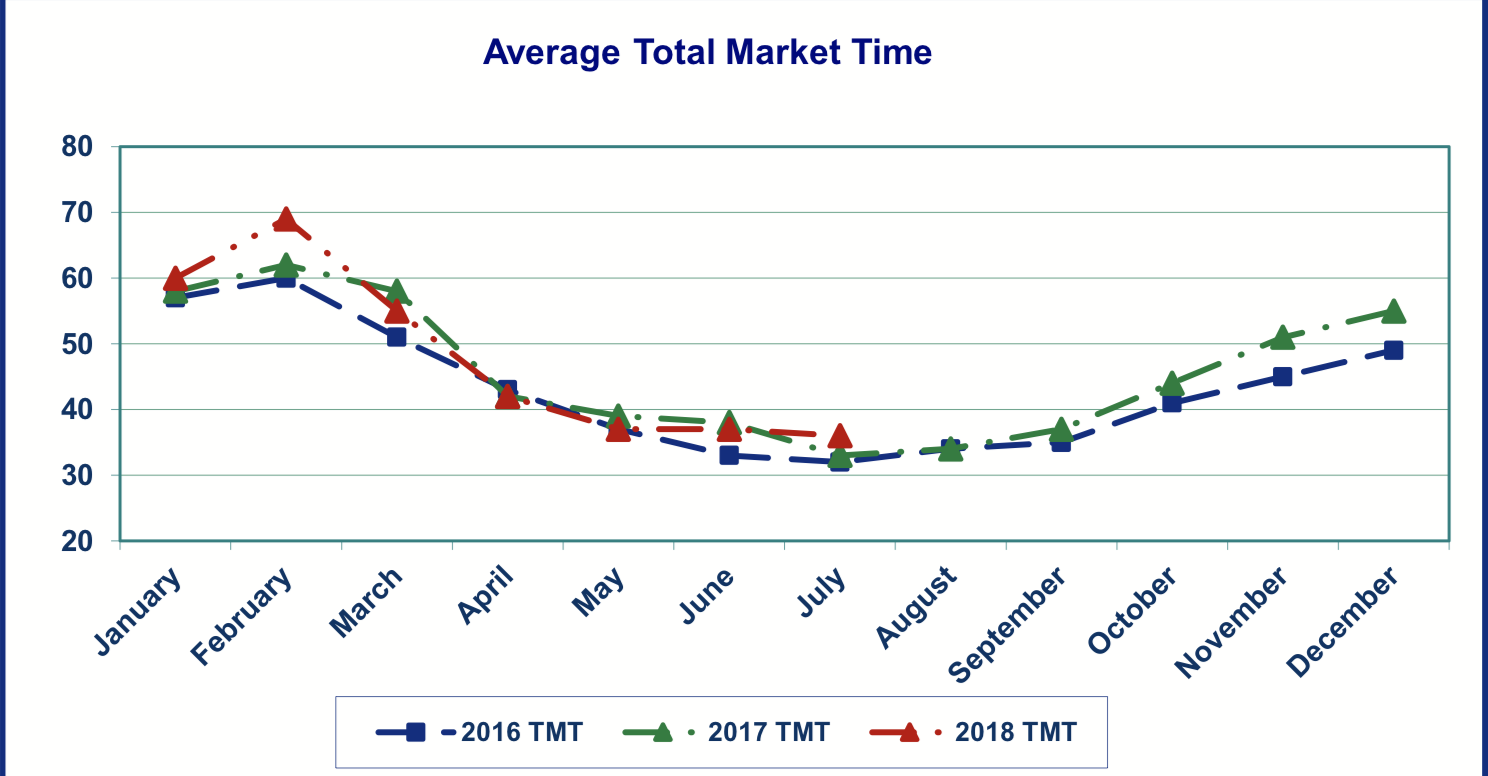
One metric showing weakness in Portland is marketing times. As evidenced in the chart below showing average total marketing times metro-wide, although following the typical seasonal pattern of the dog-days-of-August, it is now taking longer to sell properties than both 2016 and 2017. Digging a bit deeper, the higher-end of the market is feeling it more than the lower-end. Days on market in July for single-family homes in Multnomah County priced over $500K increased 30% over two years ago and 20% over one year ago. The slow-down has been tempered a bit for homes priced below $500K, but a similar pattern is developing.
So here is the real deal: Based on our own recent deals and discussions with brokers in our office, longer marketing times are going to be the norm for the foreseeable future. In other words, this pattern that the data is starting to indicate will be sticking with us. Future market data will eventually show this, but I wanted to give our clients a heads up!
Changing Markets Create Opportunities
There is a fundamental shift happening in the Portland real estate market where marketing times are expanding, buyers have a few more home choices (and time to think about those choices), and to get top dollar sellers have to rely on full-service agents to properly market their properties and reach the most buyers. The days of putting a sign in the yard and bragging about 12 offers in three days are over.
As the market shifts, opportunities arise. Right now is a great time for real estate investors to evaluate their current position. One metric that is still solid is prices. An owner’s investment property is worth more now than it ever has ever been worth. In this type of market, it is often a good idea for investors to consider a less is more strategy to increase cash flow.
Less properties can equal more cash flow?! Why yes, that is precisely what I am saying. Let’s take a look at this example:
An investor owns ten houses worth $350,000 each and owes $150,000 on each of those properties. That is $2 million in equity. Say that investor’s monthly cash flow (after expenses and debt service) is $600 a month on each property for an aggregate cash flow of $6,000 per month. That investor hires us to sell five of those homes for top dollar allowing them to pay off the five homes they still own which means they now have five houses free and clear worth $1.75 million. Without any mortgage payments, the investor’s new monthly cash flow would increase to $1,450 per unit or $7,250 per month. That is a 20 percent increase!
As investors ourselves, we always have strategies for our investor clients to maximize their returns. Call us today for a free consultation!
Doing Real Estate Right
One of the main reasons Carmel and I decided to join Windermere Realty Trust was that they make sure Realtors cross their T’s and dot their lower-case J’s. A Realtor being thorough is crucial during a transaction because it became apparent to us several years ago, as hordes of new agents flooded into the market, that sloppy transactions were becoming more common. Our clients are always protected because we won’t allow them to be put at risk and being at Windermere Realty Trust assures that.
Why is this important? Simply put, selling a house involves a large amount of money which can lead to expensive litigation. Many agents keep sloppy records and a year after closing they hardly remember their client’s name let alone the contractor that was supposed to fix the sewer line or rotting siding. All our documents are reviewed, all our documents are safely stored, and all our documents are available to protect you, our clients.
When hiring an agent trust is important. As a client, a person wants to be able to go to sleep at night knowing that there are no loose-ends and no cut corners. That is the difference you will see with us; we are always doing real estate right!
Closing Costs for Sellers

Lesser agents don’t discuss closing costs with sellers until the end of the transaction. Typically the conversation happens right about the time the seller receives their estimated settlement statement from the title company and see the thousands of dollars they are coughing up at the closing table. As you can imagine, it is typically not a pleasant conversation!
Generally, the closing costs to the seller will be less that 1% of the sales price. Laws, regulations, and customs vary by state and often by county but in Oregon most fees related to title insurance and escrow are regulated by the state. So these are not things sellers can shop around for to try and save a few bucks. As Realtors, we typically refer our clients to title companies and escrow officers that we know are great communicators and efficiently get deals done.
In Oregon it is customary for the seller to pay for the title insurance policy. The seller is saying to the buyer, “Mr. and Mrs. Buyer, I paid to insure that the property is free and clear of any liens and encumbrances that you don’t know about.”
Beyond the title insurance costs, there are escrow fees. These are expenses related to shuffling the paper around, getting signatures and recording the sale with the county. Oregon buyers and sellers typically split these fees 50/50.
If you ever have a question about how real estate transactions work, don’t hesitate to call us. With over 30 years of combined experience, we have you covered!
When is the Best Time to Buy?
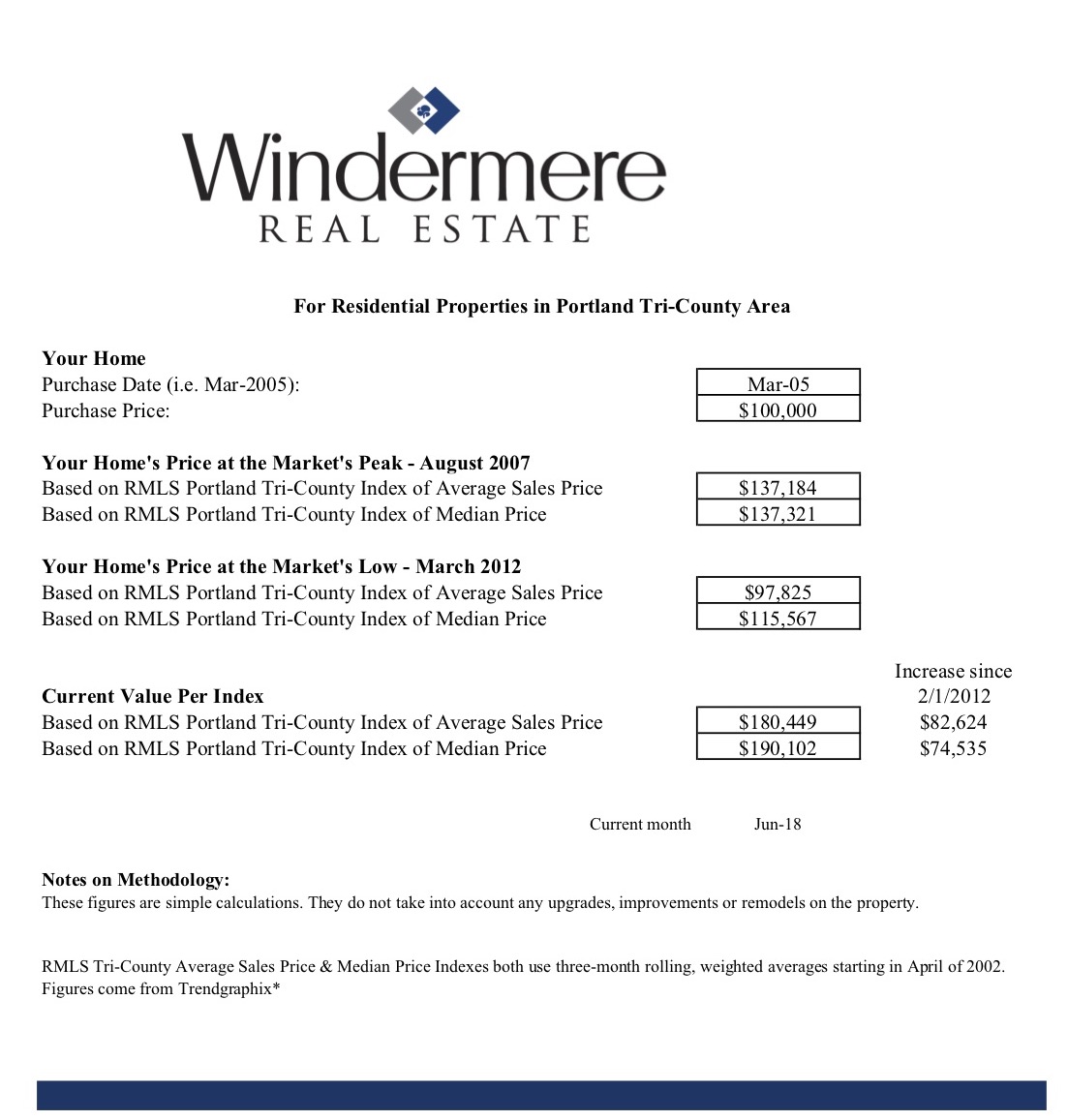
The best time to buy is usually a year before you actually purchase something. The reason is that the greatest strategy to build real wealth in real estate is to buy and hold for a long period of time. It is almost a sure bet and below is a chart that I think really illustrates my point.
Let’s say a person purchased a hypothetical property in 2005 for $100,000, cash. This was the beginning of the run-up to the market peak and based on data from RMLS for the Tri-County area, by August 2007 that property would have seen a peak value of $137,184 and that buyer was feeling groovy.
Then we saw a total market crash and that same property’s value fell to $97,825 by March 2012. So that buyer is now super bummed, stressed, and feeling far from groovy. In their mind, they have now lost $39,359 in equity. But chin up! They actually only lost $2,175 in equity (purchase price minus current market value). And in terms of actual cash, they have not lost anything since they have not sold the home.
Today, this same house is now worth $180,449. This is 80% above the original purchase price, or about 4.6% annual appreciation. They feel groovy again! Even the folks that purchased at the peak of the bubble in 2007 are feeling groovy!
Current market fundamentals are strong. 30,000-40,000 people are moving to the metro area every year and we are still behind delivering new units since we had essentially zero new inventory during the lean years. On top of that prices are still increasing faster than historical averages and inventory is tight. So my answer to “when is the best time to buy?” Its when a person has their finances in order and are ready to call Carmel and me. Good ol’ fashioned time is the greatest hedge against market instability.
Ambush Market Data Pop Quiz!
Ambush Market Data Pop Quiz! Where Tyler put Carmel’s market knowledge to the test!